

Not all communications are equally important, and not all documents you need to sign require the same level of assurance.
Sending an informational notice is not the same as pursuing an outstanding debt, notifying someone of the termination of a contract or requesting the signature of an important agreement.
The more significant the transaction, the more important it is to have the appropriate evidence to establish what happened. And, within the same type of process, the more actions you can substantiate, the greater the evidential value of the records obtained.
That is why CertyNet offers different certified electronic communications, postal communications and electronic signature services, allowing you to choose according to:
- The importance of the transaction.
- What you may need to prove at a later date.
- The recipient’s contact details available to you.
It is not simply about having more evidence, but about ensuring that the evidence is relevant to what you need to prove.
What is certified evidence?
Certified evidence is information generated and recorded during a process that makes it possible to substantiate the actions carried out throughout that process.
CertyNet records and certifies different types of evidence depending on the service selected. Once the process is complete, this evidence is compiled into an electronic evidence certificate, which allows you to establish what happened during the transaction and when each action took place. The certificate and its associated evidence are securely retained for five years and remain available for consultation and download.
The CertyNet platform is operated by MailComms Group, a Qualified Trust Service Provider. This means that the evidence generated and certified on the platform benefits from enhanced safeguards regarding its integrity, authenticity and traceability. Therefore, all services available on the platform provide evidential value.
The 3 types of CertyNet services: electronic communications, postal communications and electronic signatures
| Service type | Purpose | Available channels | When to use it |
|---|---|---|---|
| Certified electronic communications | Send PDF documents and generate evidence through electronic channels | Email / SMS / WhatsApp | Notices, claims and remote notifications |
| Certified postal communications | Send communications and deliver documents by post from your computer | Postal mail | When the recipient requires a physical channel or you do not have their electronic contact details |
| Electronic signatures | Obtain signatures on one or more documents from one or more signatories | Digital (platform) | Contracts, agreements and authorisations requiring legally valid signatures |
At CertyNet, we have organised our services into three categories according to the purpose of the process and the channel used:
- Certified electronic communications, for sending messages or PDF documents and generating evidence through electronic channels. You can choose to send them by email, SMS or WhatsApp.
- Certified postal communications, for sending communications and delivering documents through the postal service conveniently from your computer.
- Electronic signatures, when the purpose is to obtain signatures on one or more documents from one or more signatories.
Within each category, you will find three services that differ primarily in the scope of the evidence they provide and the degree to which the process can be configured.
You can choose the most suitable service based on the importance of the transaction, the evidence you need to obtain and the level of customisation required for the process.
Evidence types and service levels across different categories are not directly comparable in every case, as they relate to different purposes, channels and processes.
How to interpret the legal evidential value indicator
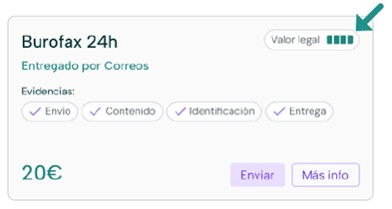
To help you choose, we have included a small icon on each service card that provides an indicative representation of the level of legal evidential value associated with the amount of evidence recorded and certified during each process.
This indicator reflects the scope of the evidence CertyNet records and certifies throughout the process, allowing you to identify at a glance which services offer greater evidential value within the same service category. The more evidence recorded, the greater the potential evidential value.
Its purpose is to make your decision easier based on the importance of the transaction and what you may need to prove. In general, the more relevant actions a process allows you to substantiate, the greater its evidential value within that category.
Remember that the indicator is primarily intended to compare services of the same type: electronic communications with one another, postal communications with one another, and signature services with one another. The evidence generated by each category relates to processes of a different nature and, therefore, their levels are not directly comparable in every case.
The legal evidential value level is an approximate, indicative reference. It does not, in itself, confer legal validity on a communication, document or contract, nor does it replace the assessment of the evidence that may be required in a specific case.
Use this indicator as a visual guide and review the specific evidence included with each service to choose the process that best suits what you need to substantiate.
What recipient details do you need for each channel?
There is another essential factor to consider when choosing a service: how you can contact the recipient.
You will need the relevant contact details for the channel you wish to use:
- Postal address, for postal communications.
- Email address, for communications sent by email.
- Mobile phone number, for SMS or WhatsApp.
You may not always have all these details. You might know someone’s email address but not their postal address, or you might only have their phone number. Furthermore, although WhatsApp is widely used, not every recipient has access to the service or uses it with the number you have.
CertyNet allows you to choose between different channels according to the contact details available to you and, when several options are possible, select the most appropriate way to reach the recipient.
Three questions to help you choose the right CertyNet service
Before carrying out a transaction through CertyNet, ask yourself these three questions:
- 1. What do you want to do? → Choose the service type
Send an electronic communication, send a postal communication or obtain a signature. - 2. What do you need to prove? → Choose the service level
Consider the importance of the transaction and which actions you may need to substantiate later. - 3. What contact details do you have for the recipient? → Choose the channel
A postal address, an email address or a mobile phone number. If you have several options, consider which is the most appropriate way to reach the recipient.
With these three answers, you can identify the service type, service level and, where applicable, the channel that best suits your transaction.
The key is not always to choose the service that generates the most evidence, but to select the one that allows you to substantiate what you actually need to prove and provides an appropriate level of legal evidential value for the importance of the transaction.
If you already know the answers to these three questions, discover which CertyNet service best suits your needs.